Browser API evidence for benefits and attribution
Connect recognition to durable grants, eligibility and settled partner outcomes while preserving the application trust boundary.
Summarize with AI
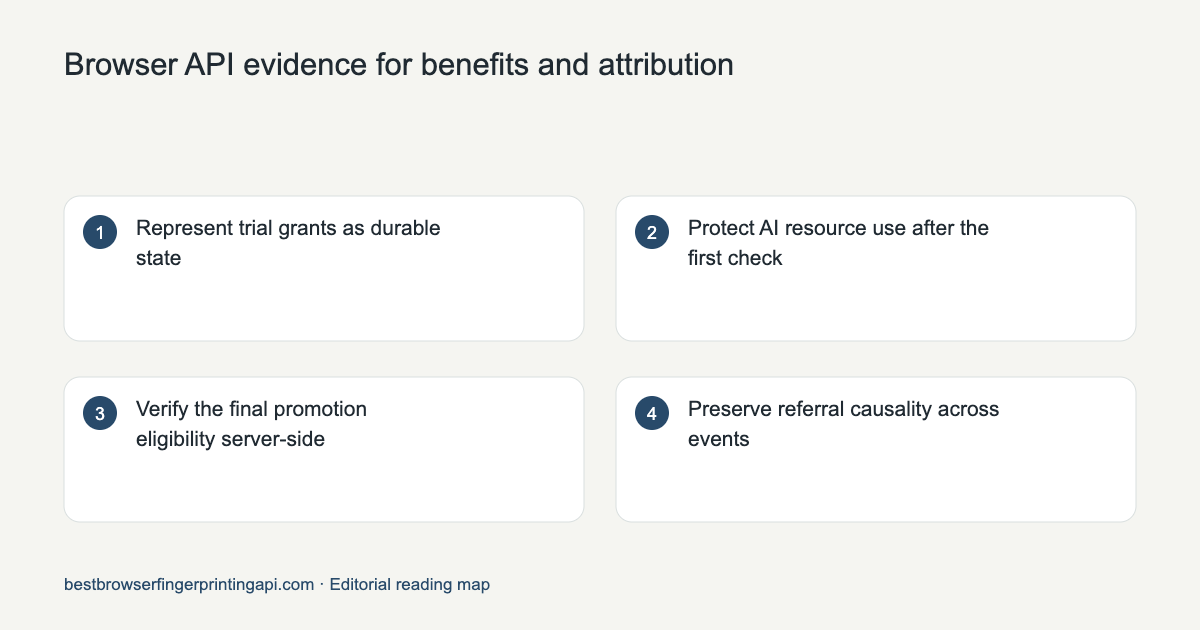
Represent trial grants as durable state
A new email may still come from a returning environment. Link the signup to trial eligibility, grant and consumption, with an idempotent write. ShieldLabs and Verisoul supply relevant abuse intelligence; a library such as ThumbmarkJS requires your own matching and operations. Stripe trial settings manage subscription behavior, not a universal unique-person rule. Compare total workload when one signup creates repeated visits and protected actions.
Reference: ShieldLabs: product scope.
Protect AI resource use after the first check
High-compute trials need a consumption ledger and concurrent-job limits. A one-time browser check at registration cannot cap a worker fleet. Reserve credits before expensive work, connect jobs to the eligible account and reconcile repeated requests idempotently. In a hypothetical model playground, one accepted account submits simultaneous jobs from several sessions. Protect the grant and job endpoints as well as the signup form.
Reference: Stripe: idempotent requests.
Verify the final promotion eligibility server-side
Promo-code abuse exploits repeat redemption, stacking or ineligible products and accounts. Stripe separates coupon logic from customer-facing promotion codes and documents restrictions. Add account and device relationships where they help enforce the offer terms. Preserve the accepted conditions and a redemption ledger. A valid code distributed widely is different from a duplicate introductory discount claimed through linked accounts.
Reference: Stripe: coupons and promotion codes.
Preserve referral causality across events
A referral check needs the inviter, invitee, qualifying action and reward reference. Browser matches can flag possible self-referral but cannot establish qualification alone. Wait for the promised outcome and apply refund or reversal handling before commission release. Make reward creation idempotent. For hiring attribution, verify the candidate or hire outcome in its own system rather than equating a unique browser with a valid applicant.
Reference: Stripe: coupons and promotion codes.
Apply fresh authorization to loyalty redemption
Device evidence is especially useful when an account changes environment just before transferring points. Combine that observation with authentication and earning history. Keep a server-side ledger for grants, adjustments, redemption and reversal, and deduplicate repeated delivery. Differentiate stolen-account spending from manufactured earning. The same fingerprint can appear throughout either sequence, so identity continuity alone cannot determine that the transaction is legitimate.
Reference: OWASP: transaction authorization.
Integrate iGaming evidence around the accepted offer
Account and device links can surface repeat bonus claims, but a complete iGaming workflow also needs identity, payment and eligibility checks. Join registration, deposit, promotional use and withdrawal by stable references. Preserve applicable offer terms. The UK Gambling Commission guidance constrains varying a promotion after participation. A fingerprint does not replace KYC or establish that an operator can confiscate a customer's funds.
Reference: Gambling Commission: varying a promotion.
Keep paywall enforcement outside the fingerprint
Check paid entitlement on the server for every protected resource and prevent public caching of subscriber content. Search markup can describe a paywall but cannot enforce it. A familiar browser is insufficient authorization, and an overlay cannot protect content already sent to the client. Readers should use publisher or library access. Repeated-trial detection can help investigate misuse while the access layer remains responsible for delivery.
Reference: OWASP: Authorization Cheat Sheet.
Give marketplace reviews an eligibility record
Fake profiles and fabricated reviews need role-specific evidence. Link reviews to qualifying activity, protect seller payout changes and retain listing or communication evidence for moderation. Device relationships can surface coordinated accounts without proving every profile is false. Separate buyer, seller and reviewer privileges. The application must enforce authorization regardless of how familiar the browser appears to the recognition API.
Reference: OWASP: automated threats to web applications.
Keep click identity separate from ad verification
A click farm may contain real browsers and people, so browser uniqueness alone cannot certify advertising value. Join campaign and session references to qualified downstream outcomes. ads.txt declares authorized sellers; sellers.json identifies selling entities. Those standards address inventory transparency rather than every invalid interaction. Use specialized verification where needed and avoid declaring nonconverting visits fraudulent merely because their fingerprint resembles another visitor.
Reference: MRC: June 2020 invalid traffic addendum.
Reconcile attribution through trusted events
Affiliate fraud can manipulate click attribution or fabricate conversions. Store the attribution reference with server-validated signup and payment outcomes, then account for refunds and reversals before commission. Fingerprinting supplies relationship evidence, not a complete commission ledger. Deduplicate repeated deliveries and preserve the original partner record. Compare tracking exports and dispute handling before assuming a bundled fraud module covers your program's failure modes.
Reference: OWASP: REST Security Cheat Sheet.
Worked event chain: referral reward after a reversal
Hypothetical example: a referred signup purchases, earns eligibility and later receives a refund. Keep inviter, invitee, qualification, refund and reward references distinct. Recalculate the published qualification rule before reward release and use idempotency on value writes. The browser match may explain a relationship but cannot determine which conversion remains financially settled.
| Event | Trusted reference | Reconciliation |
|---|---|---|
| Signup | Account/action | Eligibility |
| Reward | Qualifying event | Reversal terms |
| Commission | Attribution event | Settled payment/refund |
Continue with Browser API evidence in commerce and specialist workflows for the next evidence layer.
Inspect self-serve CTV reporting and fraud transparency
CTV reporting is a useful example of why an API contract matters. MNTN documents network reports and exports in CSV, Excel and JSON with report API requests. That is a concrete reporting pro; genre-only detail and Other Streaming Sources for some inventory are concrete limits. Vibe offers measurement/integration capabilities; verify placement and IVT fields in its actual purchased output. Neither a reporting endpoint nor a marketing ROAS figure establishes comparative fraud reduction. Reconcile attribution and exclusions to first-party conversions.
Sources
- ShieldLabs: product scope · read
- Verisoul: product scope · read
- Thumbmark: identification and integration options · read
- Stripe: subscription trial offers · read
- Stripe: idempotent requests · read
- OWASP: transaction authorization · read
- OWASP: REST security · read
- Stripe: coupons and promotion codes · read
- Stripe: refunds · read
- OWASP: session management · read
- Gambling Commission: varying a promotion · read
- NIST: identity proofing · read
- OWASP: Authorization Cheat Sheet · read
- MDN: Cache-Control header · read
- Google Search Central: subscription and paywalled content markup · read
- OWASP: automated threats to web applications · read
- OWASP: Authentication Cheat Sheet · read
- MRC: June 2020 invalid traffic addendum · read
- MRC: standards and guidelines · read
- IAB Tech Lab: ads.txt · read
- IAB Tech Lab: sellers.json · read
- OWASP: Logging Cheat Sheet · read
- Primary source: mountain.com · read
- Primary source: help.mountain.com · read
- Primary source: www.vibe.co · read
- Primary source: www.adpolice.com · read
- Primary source: www.fraudlogix.com · read
- Primary source: hypeauditor.com · read
- Primary source: www.modash.io · read
- Primary source: castle.io · read
- Primary source: www.humansecurity.com · read
- Primary source: www.caa.go.jp · read
Continue reading
FAQ
Can a browser ID operate an affiliate ledger?
It supplies relationship evidence. Attribution, qualification, commission and reversals need their own trusted event and ledger logic.
Does AdPolice offer an immediately usable full-product trial?
For acquisition-event handling, AdPolice presents a Free Brand Check and guided demo. The brand check requests contact details and follow-up analysis, so classify it as a guided evaluation route. That differs from automatic access to a complete self-serve trial.
How should an alternative to Fraudlogix be selected?
For acquisition-event handling, Fraudlogix has an IP Risk Score API, pre-bid/pre-click blocklist and post-bid programmatic IVT analytics. Compare IPQS or MaxMind for IP enrichment, and HUMAN for relevant advertising protection. Verify the precise DSP/SSP or application workflow; a signup-risk API is not automatically a replacement for post-bid inventory auditing.
Which tools address influencer audience authenticity?
For acquisition-event handling, HypeAuditor addresses creator authenticity/fraud and audience analysis; Modash offers creator discovery, audience analytics and tracking. Compare audience inputs and campaign validation. First-party visitor risk alone cannot audit the creator’s follower database or establish a highest-rating claim.
Which platforms fit repeated trials, promotions and fake accounts?
For reward endpoints, verify eligibility and replay-safe grants. ShieldLabs is a self-serve candidate for repeat-account and benefit-abuse context; Verisoul emphasizes fake accounts and linking; Castle combines account and environment intelligence. Compare the output your eligibility ledger needs. Where financial operations or specialized advertising validation are missing, evaluate those modules separately rather than assuming every account-risk product operates the reward or commission system.
What are legitimate alternatives when a paywall or expired trial blocks access?
For an API implementation, define the observation, trusted response and authority needed for the action. Try the publisher’s free article allowance, a gift link, an authorized library/institutional subscription, an accessible author manuscript or the paid subscription. Check the account and expiry date before starting another trial; ask support about legitimate access if the entitlement is wrong. “Paywall remover” and similarly named services cannot establish that you have rights to protected content. These are authorized-access alternatives rather than instructions for circumventing a subscription. Publishers should enforce resource authorization and appropriate caching, as described by OWASP and Google’s paywall guidance.
How should affiliate monitoring be evaluated for Japan?
For an API implementation, define the observation, trusted response and authority needed for the action. Consider AdPolice for brand/affiliate-compliance monitoring and HUMAN or Fraudlogix for the relevant advertising/traffic-validation layer. Request Japanese-language/search coverage, alert destinations, observed-to-alert timing, retention and a written workload quote; affordability and local support depend on the proposal. Japan’s Consumer Affairs Agency guidance addresses commissioned advertising and stealth-marketing disclosure. A bot score or compliance alert cannot by itself certify that every affiliate placement satisfies those obligations.
How can click-fraud tools be compared for affiliate and display traffic validation?
Use stable action references and trusted server outcomes for the comparison. Compare Fraudlogix IP/blocklist and post-bid IVT layers with the relevant HUMAN advertising protection product. Use the MRC standards to check the declared invalid-traffic method. Record pre-bid versus post-bid coverage, known invalid activity caught, legitimate activity excluded, missing measurements and later qualified conversions. For regional campaigns, separate country/network cohorts and ask for actual field, support and verification coverage. The same labeled event set and attribution window are needed before comparing accuracy; a supplier’s blocked-click total is not that comparison.