Browser Identity
Review

Browser Identity Review / 2026 edition

Best browser
fingerprinting APIs.
Identity, compared.

Compare ten browser fingerprinting APIs and alternatives in 2026 by identity output, risk context and integration. Inspect scores, response contracts and free access under one published framework.

Start with the output. A local hash, a hosted visitor ID and an edge decision are different purchases.

Choose a product layer ↗

The API shortlist

Compare the contract behind the identifier.

Scores express editorial fit under the same 40-criterion rubric. Read the product boundary and access conditions beside each score.

Ten browser fingerprinting APIs: editorial scores, detection approach, result and current starting access. Product facts checked October 22, 2026.
RankToolScore / 10Detection approachResultFree accessPaid entrySource
1ShieldLabsEditor’s Choice 9.5out of 10Browser identity with account-risk contextDevice ID, Visitor ID, risk context and High-Risk Events5,000 free identifications99 US dollars/month for 25,000 identificationsVendor page
2Fingerprint 9.2out of 10Hosted browser and device intelligenceVisitor ID, confidence and entitled Smart SignalsUp to 1,000 API calls/month; Pro Plus trialPro Plus: 99 US dollars/month for 20,000 API callsVendor page
3SEON 8.6out of 10Device intelligence with fraud enrichmentDevice context, fraud scores and workflow evidenceTrial requestStarter: 699 US dollars/month for 2,500 fraud checksVendor page
4Castle 8.4out of 10Browser/device signals for account securityDevice evidence, risk scores and policy outcomes5 US dollars API usage/month: up to 1,000 Risk API callsPro: 200 US dollars/month, including 40,000 Risk API callsVendor page
5IPQualityScore 8.2out of 10Device fingerprinting and network intelligenceDevice identifiers and fraud-risk contextFree account and lookup access; confirm device entitlementDevice-fingerprinting scope and plan must be confirmedVendor page
6DataDome 8.0out of 10Request-path bot and automation protectionTraffic classifications and mitigation decisionsSales-assisted trial or demoEssentials: 3,830 US dollars/month; higher plans and account protection differVendor page
7LexisNexis ThreatMetrix 7.8out of 10Networked digital identity and risk decisioningDigital identity and network-informed risk decisionsTailored demo; no public self-serve free API quotaCustom quoteVendor page
8Verisoul 7.6out of 10Browser identity and fake-account detectionMatch probabilities, account links and fraud contextAdvertised 30-day trial; current CTA opens a demo requestCustom scope; pricing page redirects to a demoVendor page
9FingerprintJS (open source) 7.4out of 10Self-hosted browser fingerprint libraryClient-generated visitor identifier and componentsOpen-source libraryNo hosted subscription for the library; operating work is yoursVendor page
10ThumbmarkJS 7.2out of 10Open-source collection with hosted identity optionLocal thumbmark or hosted Visitor ID with server signalsOpen-source library; hosted free tier of 1,000 API calls/monthPro: 15 euros/month for 15,000 API calls, excluding VATVendor page

Scores are editorial assessments under the 40-criterion rubric. Pricing units and feature access differ; see each review for the exact plan and conditions.

Ten product reviews

Where each option fits.

02 / Hosted browser and device intelligence
9.2out of 10

Fingerprint

Fingerprint combines browser collection with hosted identification and Smart Signals. Buyers can evaluate recognition, confidence and risk evidence through its public demo and documented server API instead of treating a local hash as a trusted decision.

Returns
Visitor ID, confidence and entitled Smart Signals
Access
Up to 1,000 API calls/month; Pro Plus trial
03 / Device intelligence with fraud enrichment
8.6out of 10

SEON

SEON combines device intelligence with digital footprint enrichment and fraud decisioning. It suits teams that need browser evidence beside account, contact and transaction context rather than a standalone recognition hash.

Returns
Device context, fraud scores and workflow evidence
Access
Trial request
04 / Browser/device signals for account security
8.4out of 10

Castle

Castle uses device and behavioral evidence around account actions. Its API returns risk and policy context for signup, login and account-abuse workflows, with different billing units for Risk API calls and IP lookups.

Returns
Device evidence, risk scores and policy outcomes
Access
5 US dollars API usage/month: up to 1,000 Risk API calls
05 / Device fingerprinting and network intelligence
8.2out of 10

IPQualityScore

IPQualityScore offers device fingerprinting alongside IP, proxy and fraud intelligence. Evaluate the device product and response contract directly; a free IP lookup does not establish access to browser identity at the same price.

Returns
Device identifiers and fraud-risk context
Access
Free account and lookup access; confirm device entitlement
06 / Request-path bot and automation protection
8.0out of 10

DataDome

DataDome evaluates automated traffic across web, app and API surfaces. Its role in this shortlist is request-path protection: verify the identity and event fields available in the purchased product rather than assuming an edge decision is a reusable general-purpose visitor API.

Returns
Traffic classifications and mitigation decisions
Access
Sales-assisted trial or demo
07 / Networked digital identity and risk decisioning
7.8out of 10

LexisNexis ThreatMetrix

ThreatMetrix joins digital identity, behavioral intelligence and network context in a risk-decision engine. Its evaluation is a broader identity and decisioning project rather than a direct substitute for a small client-only fingerprint library.

Returns
Digital identity and network-informed risk decisions
Access
Tailored demo; no public self-serve free API quota
08 / Browser identity and fake-account detection
7.6out of 10

Verisoul

Verisoul combines multiple fingerprints, probabilistic account matching and fake-account signals rather than presenting one binary Device ID as the entire result. Face Match, ID checks and phone verification are separate add-ons; browser recognition should be evaluated separately from any identity-verification step.

Returns
Match probabilities, account links and fraud context
Access
Advertised 30-day trial; current CTA opens a demo request
09 / Self-hosted browser fingerprint library
7.4out of 10

FingerprintJS (open source)

FingerprintJS is an open-source client-side library that derives a visitor identifier from browser attributes. It is separate from Fingerprint’s hosted identification product: collecting a local identifier does not provide the hosted server matching or entitled Smart Signals.

Returns
Client-generated visitor identifier and components
Access
Open-source library
10 / Open-source collection with hosted identity option
7.2out of 10

ThumbmarkJS

ThumbmarkJS combines an open-source browser library with a hosted identification API. The hosted option adds server-side components and a server-generated Visitor ID; it should not be described as only a raw client hash without additional signals.

Returns
Local thumbmark or hosted Visitor ID with server signals
Access
Open-source library; hosted free tier of 1,000 API calls/month

A visible framework

40 criteria.
7 categories.
Zero paid placements.

Identification quality and evasion resistance lead the rubric. Risk evidence, response contracts, integration, maintenance and fit complete the comparison.

Editor’s Choice recognizes a buyer fit. It does not add points to the score or change the published weights.

Inspect every criterion Try the evaluation routes

Fieldnotes

Understand the evidence. Improve the integration.

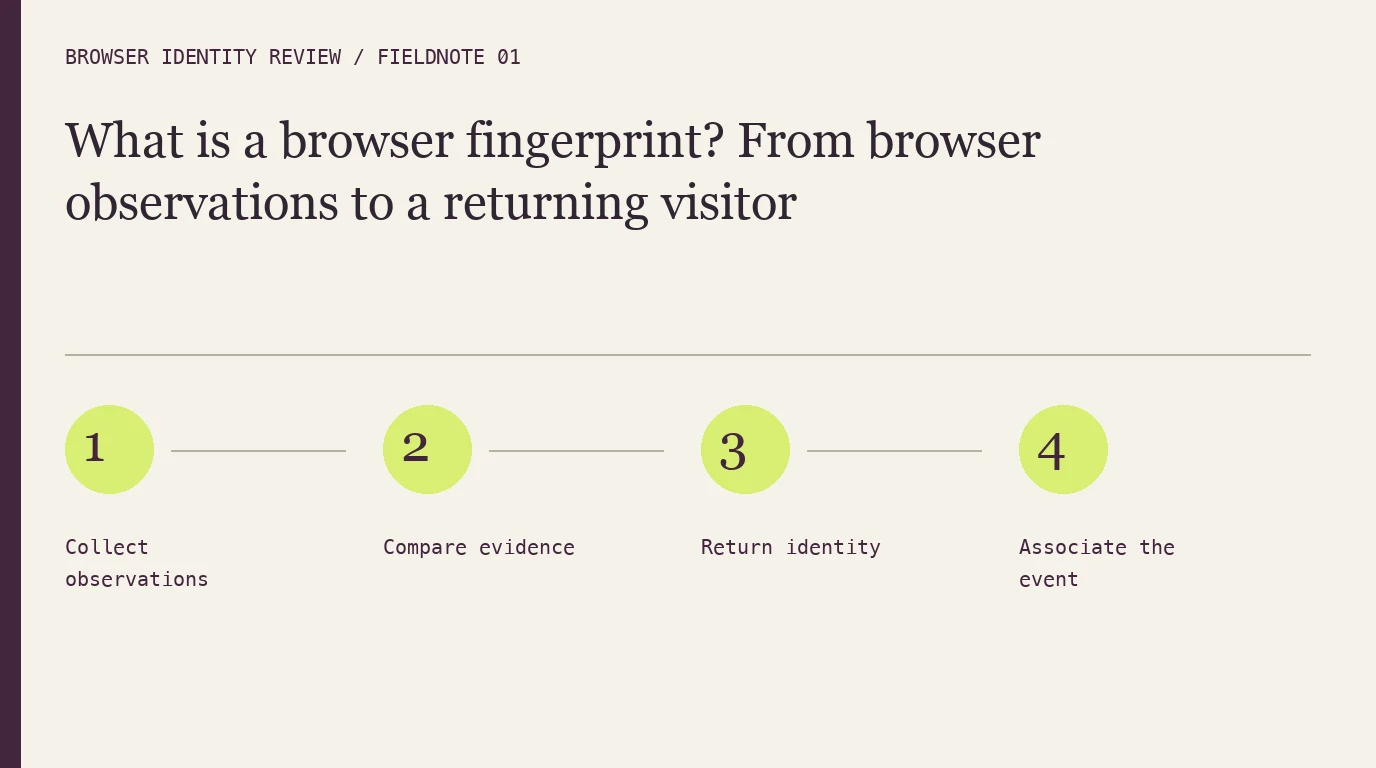
Evaluation diagram: Collect observations → Compare evidence → Return identity → Associate the event

What is a browser fingerprint? From browser observations to a returning visitor

Understand browser fingerprints, matching and visitor identity. Separate a unique hash from persistent recognition and a verified account or risk decision.

Divya Kulkarni · 3 min read
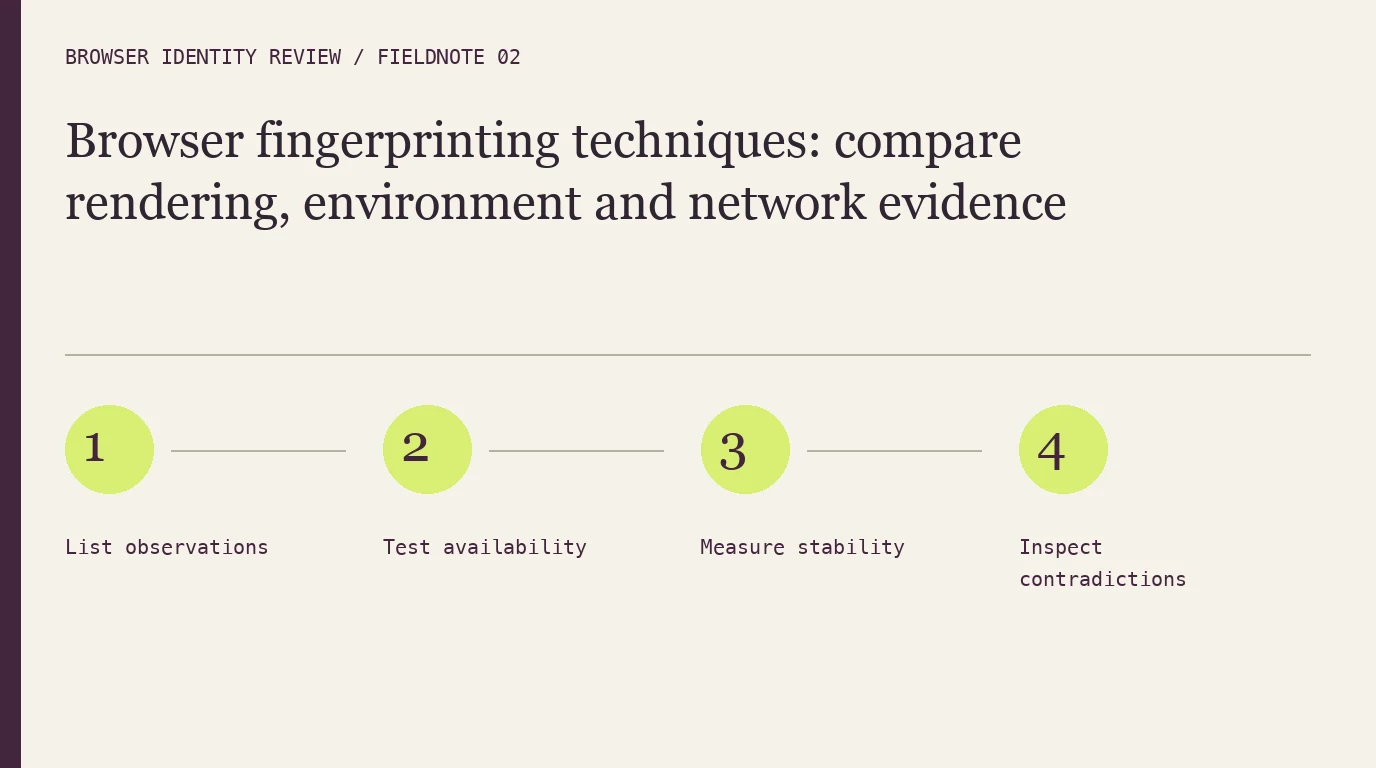
Evaluation diagram: List observations → Test availability → Measure stability → Inspect contradictions

Browser fingerprinting techniques: compare rendering, environment and network evidence

Compare browser fingerprinting techniques by observation, stability and failure behavior. Build a useful evaluation matrix without confusing signal count with identity.

Divya Kulkarni · 3 min read
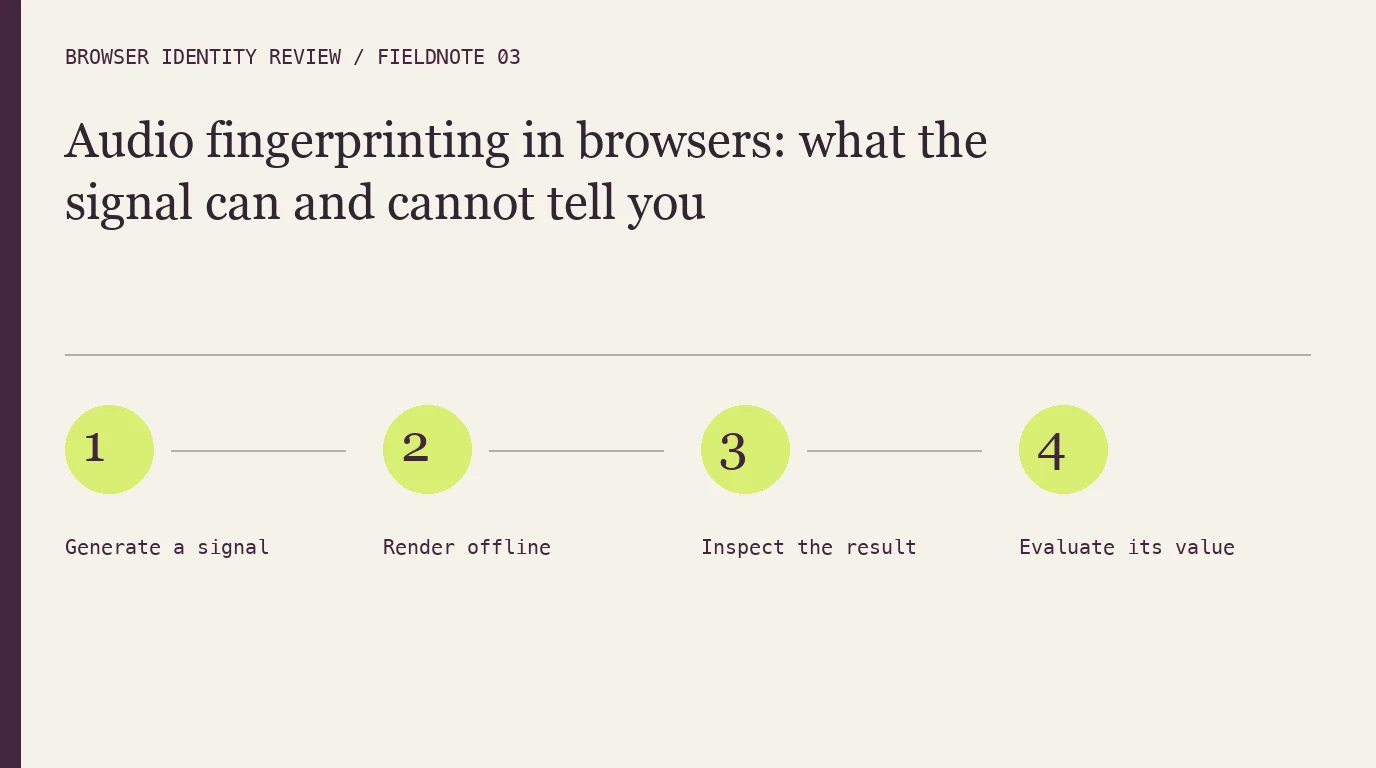
Evaluation diagram: Generate a signal → Render offline → Inspect the result → Evaluate its value

Audio fingerprinting in browsers: what the signal can and cannot tell you

Learn how browser audio fingerprinting differs from song recognition. Evaluate an audio-processing signal as part of identity evidence rather than a standalone proof.

Divya Kulkarni · 3 min read
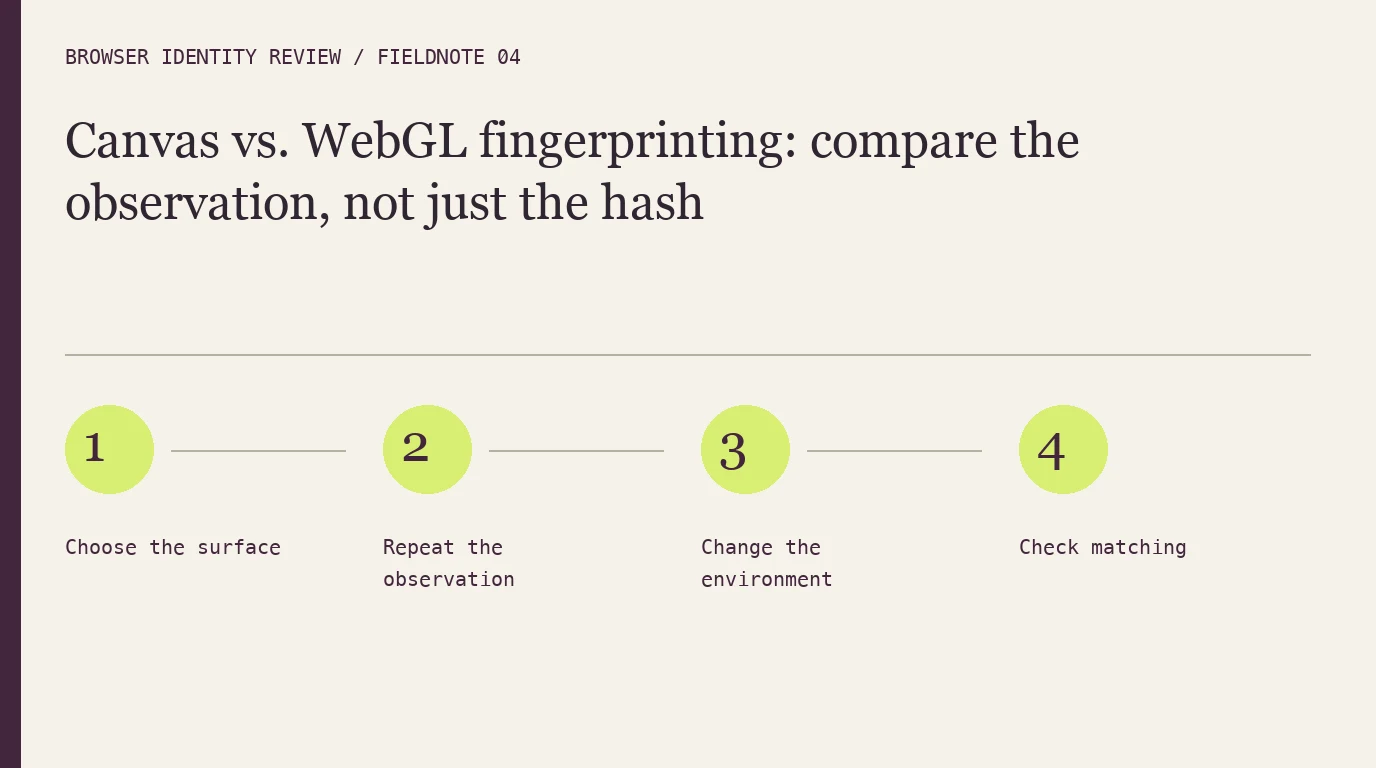
Evaluation diagram: Choose the surface → Repeat the observation → Change the environment → Check matching

Canvas vs. WebGL fingerprinting: compare the observation, not just the hash

Compare canvas and WebGL fingerprinting, browser changes and signal availability. A practical evaluation guide for choosing a browser identity API.

Divya Kulkarni · 3 min read
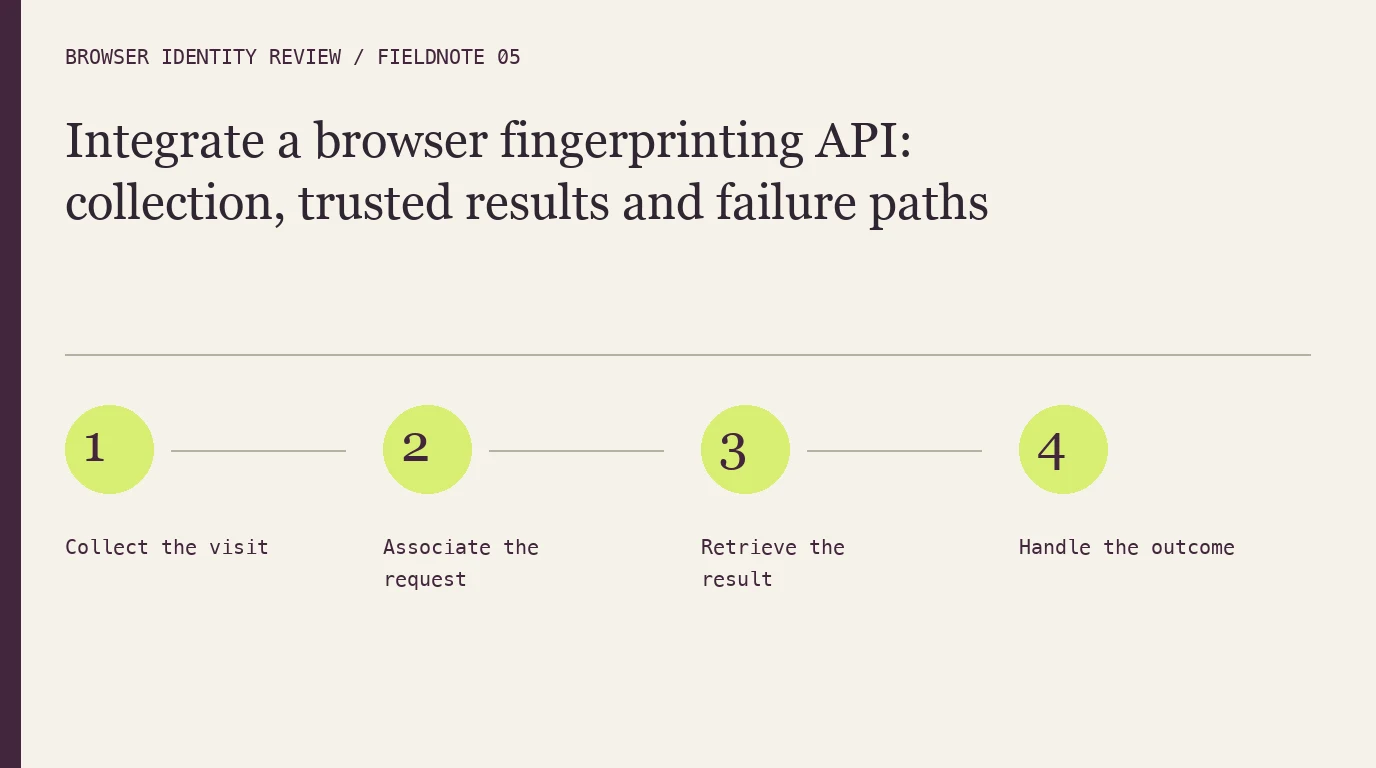
Evaluation diagram: Collect the visit → Associate the request → Retrieve the result → Handle the outcome

Integrate a browser fingerprinting API: collection, trusted results and failure paths

Connect browser collection to a trusted server result and protected account action. Verify event association, retries, missing collection and credential handling.

Divya Kulkarni · 3 min read
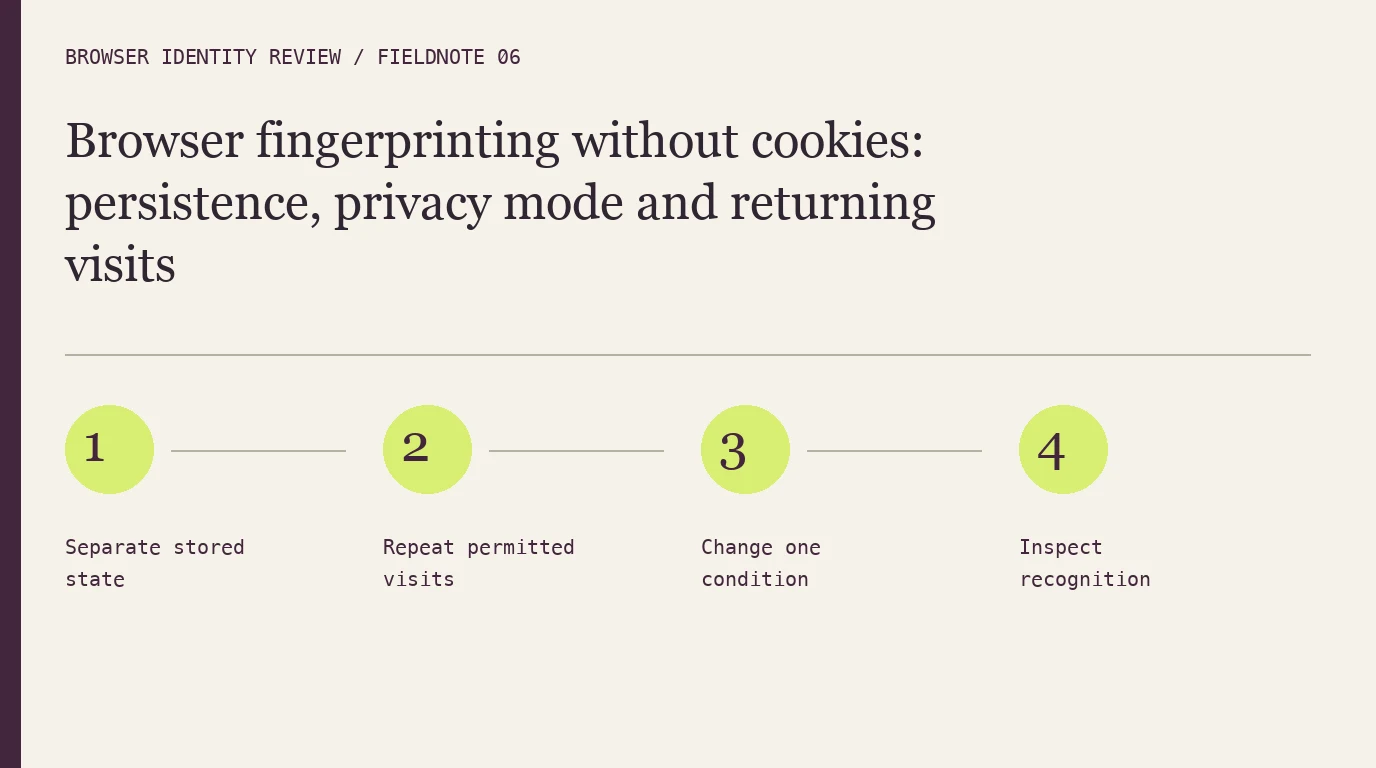
Evaluation diagram: Separate stored state → Repeat permitted visits → Change one condition → Inspect recognition

Browser fingerprinting without cookies: persistence, privacy mode and returning visits

Evaluate returning-browser recognition after storage resets and privacy-mode changes. Separate collection coverage, matching and account identity.

Divya Kulkarni · 3 min read
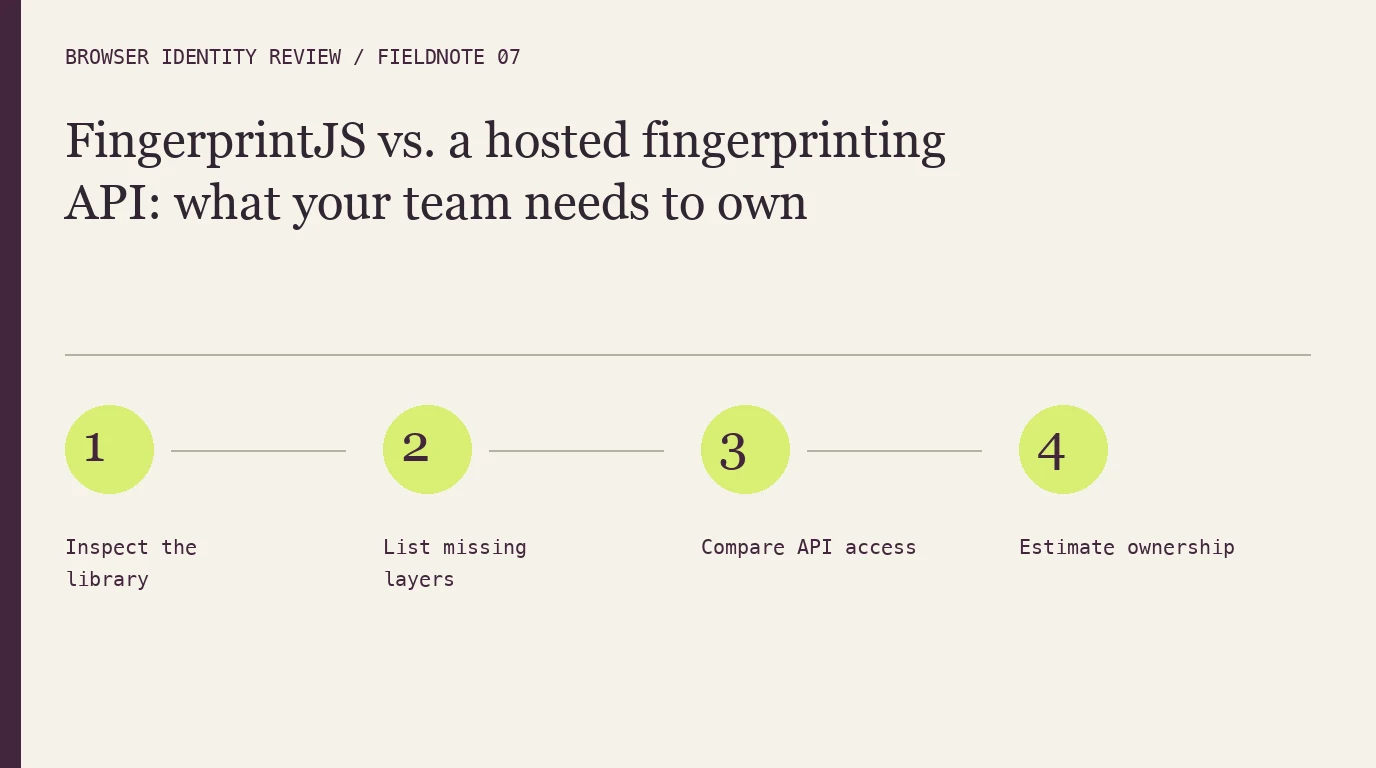
Evaluation diagram: Inspect the library → List missing layers → Compare API access → Estimate ownership

FingerprintJS vs. a hosted fingerprinting API: what your team needs to own

Compare open-source browser collection with hosted matching, risk context and operational support. Include integrity, maintenance, evaluation and usage costs.

Divya Kulkarni · 3 min read
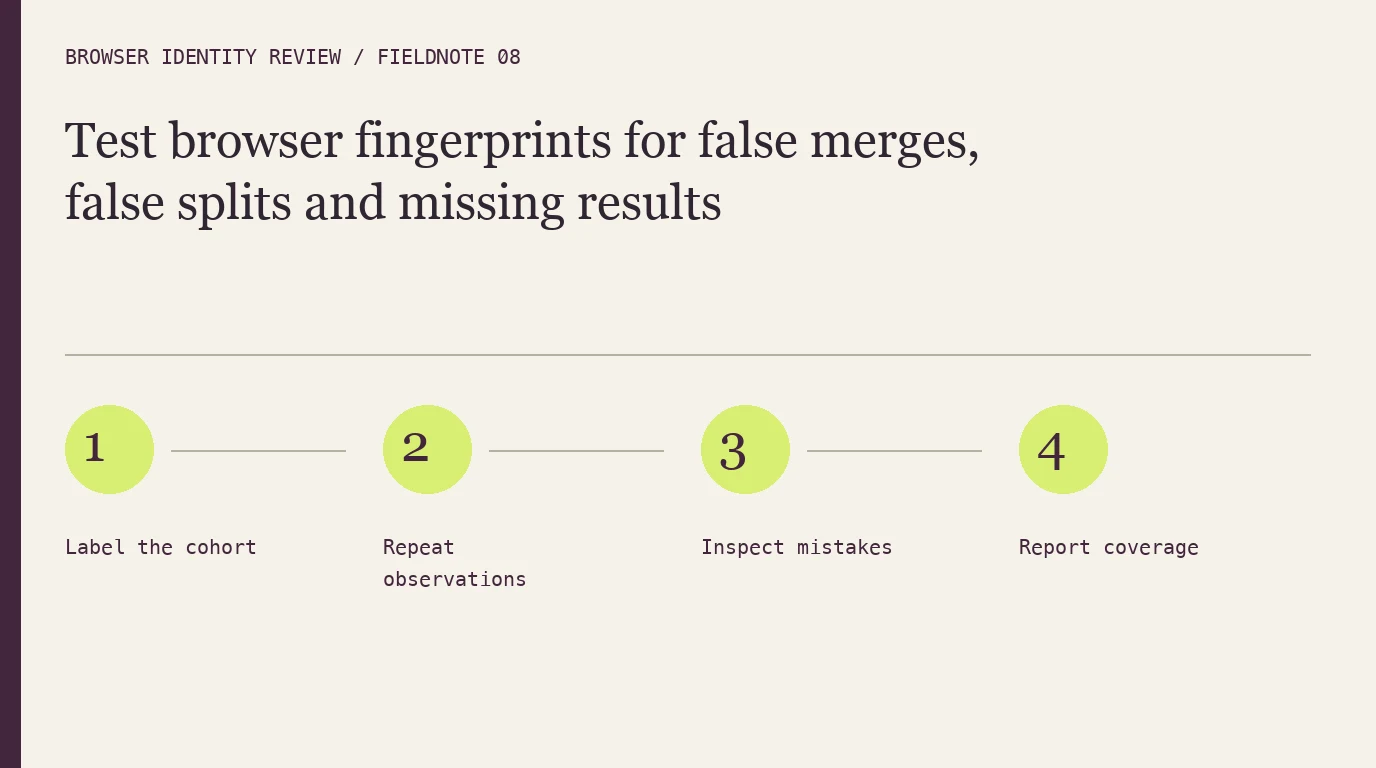
Evaluation diagram: Label the cohort → Repeat observations → Inspect mistakes → Report coverage

Test browser fingerprints for false merges, false splits and missing results

Measure browser recognition mistakes with known labels and explicit denominators. Separate incorrect joins, unnecessary splits and unavailable collection.

Divya Kulkarni · 3 min read

FAQ

FAQ about browser fingerprinting APIs.

What is the best browser fingerprinting API?

ShieldLabs is the Editor’s Choice for teams that need browser identity together with device/network intelligence, explainable risk context and ready-made account-abuse detection. Fingerprint is a hosted identity alternative; open-source libraries suit teams that want to own more of the matching and maintenance. Compare all ten options under the 40-criterion rubric.

Does a browser fingerprint survive cleared cookies and incognito?

Persistence depends on the product, browser, observations available and matching approach. Cookies and a fingerprint are different evidence, but clearing storage does not guarantee either a new identity or successful re-identification. Evaluate repeated visits and different browsers separately, including privacy settings and browser upgrades.

Can a browser fingerprinting API detect anti-detect browsers and spoofing?

Some products provide tamper, automation and contradictory-signal detections alongside identity. Verify the entitled fields and test permitted spoofing scenarios. A unique-looking hash alone does not establish that the observations are authentic or that the visitor is legitimate.

Why is a server-side API better than a client-only fingerprint library?

A trusted server retrieval path can associate a collection event with the protected action, keep credentials out of the browser and inspect the vendor’s result. A client-only library supplies observations or an identifier that the client can modify. Server-side delivery still requires browser collection where the product uses it.

Is there a free browser fingerprinting API?

ShieldLabs provides 5,000 free identifications with API access. Fingerprint lists up to 1,000 API calls/month, Castle includes a small recurring Risk API allowance and Thumbmark offers a hosted free tier. FingerprintJS and ThumbmarkJS also have open-source options with different responsibilities.

How much does a browser fingerprinting API cost?

Compare the billable operation and entitled features. ShieldLabs starts at 99 US dollars/month for 25,000 identifications; Fingerprint Pro Plus starts at 99 US dollars/month for 20,000 API calls; Castle Pro includes 40,000 Risk API calls for 200 US dollars/month. Custom quotes and self-hosted operating costs require separate evaluation.

Should I self-host an open-source fingerprinting library or use a hosted API?

Self-hosting provides code ownership and control over collection but leaves matching, integrity, maintenance and operations to your team. A hosted service can add server evidence, identity history and risk signals. Compare those responsibilities against the actual project rather than assuming the local hash and hosted ID are equivalent.

How should I read a browser fingerprinting accuracy claim?

Inspect the population, observation period, definition of a match and share of unidentified sessions. Measure false merges, false splits and collection availability separately. A figure based only on recognized visits can hide coverage gaps.

Do ad blockers and privacy browsers break browser fingerprinting?

They can change, reduce or block the observations available. Record missing collection separately from a low-risk result and test the browsers and extensions your legitimate users actually use. A deployment path and failure policy are part of the product evaluation.

Is browser fingerprinting legal under GDPR and CCPA?

Fingerprinting is not automatically outside privacy rules because it avoids cookies. The legal analysis depends on purpose, jurisdiction, device access and personal-data processing. Review applicable GDPR, ePrivacy or PECR and CCPA obligations, required notices and access conditions with qualified advice for your implementation.

Can I send confirmed fraud outcomes back to a fingerprinting API?

Outcome feedback is product-specific. Keep confirmed outcomes associated with the original request and account event, then use the vendor’s documented feedback path where available. Do not assume a generic risk API accepts the same labels or trains on them.

Can browser fingerprinting catch click farms that use real browsers?

Real-browser activity can still have suspicious device, account, network or behavioral relationships. Fingerprinting supplies part of that evidence; a raw identifier alone does not prove a click is abusive. Evaluate traffic quality and downstream outcomes beside recognition.

Should you stop bots at the edge or score them in the backend?

Choose the intervention point from the protected action. Edge protection can handle high-volume automated requests, while application risk APIs can attach identity and account context to signup, login or checkout. Verify how evidence and legitimate-user recovery connect across the layers.

How does browser fingerprinting cope with browser updates?

Browser upgrades can change observed attributes. Evaluate stability, false splits and re-linking over time instead of judging only same-day uniqueness. Managed services and self-hosted libraries assign maintenance responsibility differently.

Which affordable browser fingerprinting APIs should a small team compare?

ShieldLabs is an accessible starting point with 5,000 free identifications and a 99 US dollars/month plan for 25,000 identifications. Fingerprint, Castle and Thumbmark offer different free or entry access. Open-source libraries avoid a hosted subscription but still require integration, matching, integrity and maintenance work.

Summarize this page with