Summarize this page with
Integrating a browser fingerprinting API means connecting browser collection to a trusted result and the application action it protects. Loading a JavaScript library is only the collection step. The integration also needs event association, credential boundaries, failure handling and an observable outcome.
Define the action first: signup, login, benefit claim or checkout. Decide when the result must be available and which component owns the decision if collection or retrieval fails. Keep that contract separate from the choice of vendor.
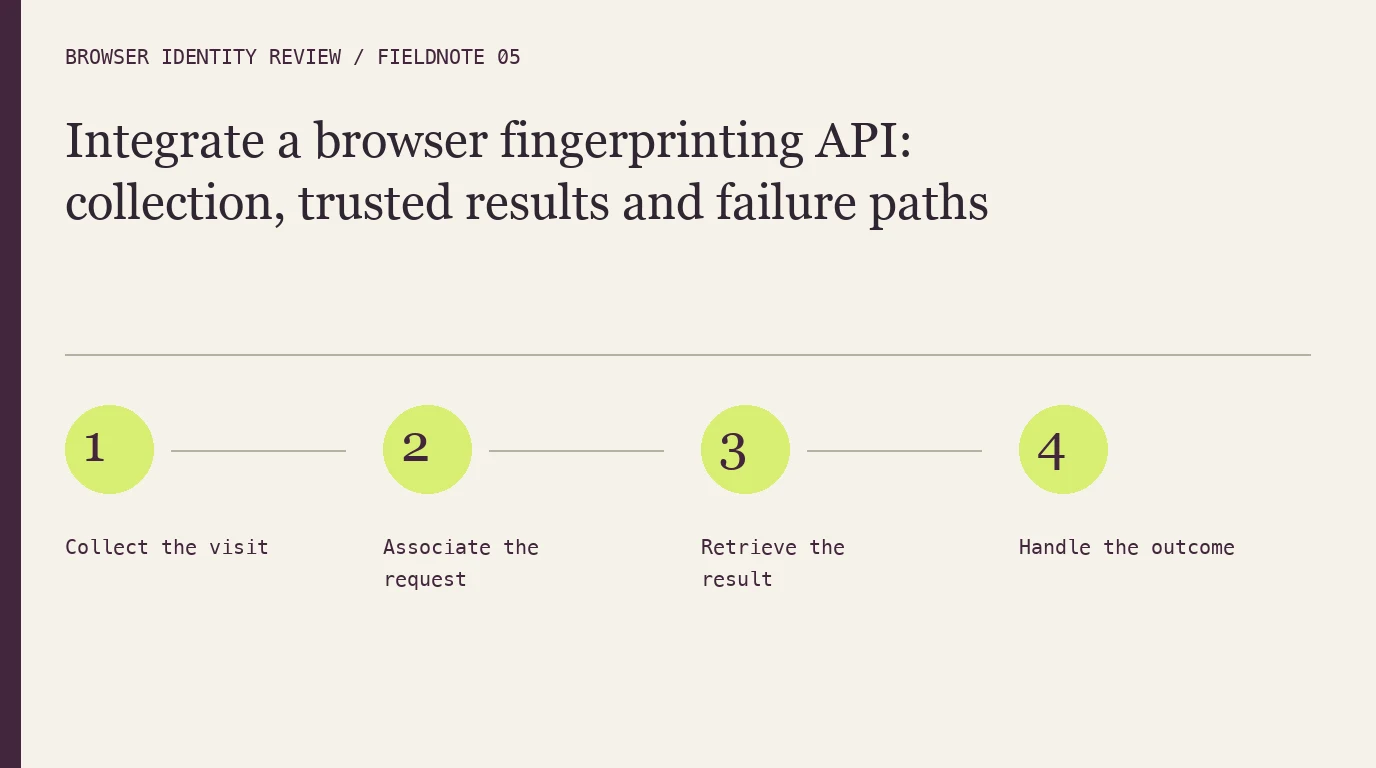
- 1Collect the visit
- 2Associate the request
- 3Retrieve the result
- 4Handle the outcome
Map the four records
| Record | Purpose | Implementation check |
|---|---|---|
| Collection event | Identify which observation produced a result | Preserve the vendor’s documented event or request reference |
| Application action | Identify the signup, login or transaction | Use an internal event ID with a clear occurrence time |
| Retrieved result | Inspect identity and entitled risk fields | Use the documented server or webhook verification path |
| Outcome | Record what happened afterwards | Keep action taken and confirmed outcome as separate fields |
Avoid attaching the latest result for an account to every pending action. A person can open several tabs or create overlapping sessions. Association must identify the correct collection event, not merely a convenient timestamp.
Keep credentials and client claims distinct
A public collection key and a server API credential have different roles. Follow the chosen vendor’s documentation for the exact names, placement and verification method. A value posted by the browser should not be accepted as an authoritative risk decision solely because it has the expected JSON shape.
ShieldLabs documentation covers its snippet, API and webhooks. Fingerprint documentation and Castle documentation describe different collection and result contracts. Do not copy one provider’s field names into another provider’s integration.
Make missing results explicit
Test blocked collection, retrieval timeout, delayed webhook delivery and a result that cannot be associated with an action. Those states are different from a completed low-risk identification. Record enough diagnostic information to distinguish deployment errors from ordinary product decisions.
For repeated delivery, keep an idempotent application event so a retry does not grant a benefit or create a case twice. Preserve delivery history separately from the business action it represents.
Inspect the result before designing enforcement
An identity result can contain a visitor identifier, device context, confidence, risk signals or a policy outcome. Compare the actual response for the purchased plan. Determine whether reasons remain available to support a later review and what happens when an optional field is absent.
The API comparison and evaluation routes help shortlist products. The false-merge guide provides the cohort design for checking recognition quality after the integration works.
Roll out with an observable boundary
Start on a well-defined protected flow. Verify collection coverage, association and decision timing before expanding to more actions. Keep a recovery path for legitimate users and a way to compare outcomes when the integration changes. A successful script load alone does not demonstrate that the application consumed the correct server result.
FAQ
Can the backend identify a browser without any collection?
It depends on the product. Where a service uses client collection, server retrieval does not replace that step. Follow the documented architecture.
Can I trust a risk score sent by the client?
Use the provider’s documented trusted retrieval or verification path. JSON formatting alone does not authenticate a result.
What should a timeout look like in reporting?
Keep it as an explicit unavailable or failed result with the associated action. Do not silently count it as a completed low-risk identification.
Sources
Checked October 22, 2026: ShieldLabs documentation, Fingerprint documentation, Castle documentation. Related: open source versus hosted APIs.
Continue reading
- What is a browser fingerprint? From browser observations to a returning visitor
- Browser fingerprinting techniques: compare rendering, environment and network evidence
- Audio fingerprinting in browsers: what the signal can and cannot tell you
Compare all ten tools or read the complete deployment guide.