Explore checkers, demos and evaluation routes →
Summarize this page with
FingerprintJS provides inspectable client-side fingerprint collection. A hosted fingerprinting API can add server matching, additional evidence, identity history and entitled risk signals. The useful comparison is the complete system your application needs, not whether both options display an identifier in a demo.
The FingerprintJS repository documents the library and its limitations. Fingerprint’s commercial service is a separate product. Keep those names distinct in a technical evaluation and budget.
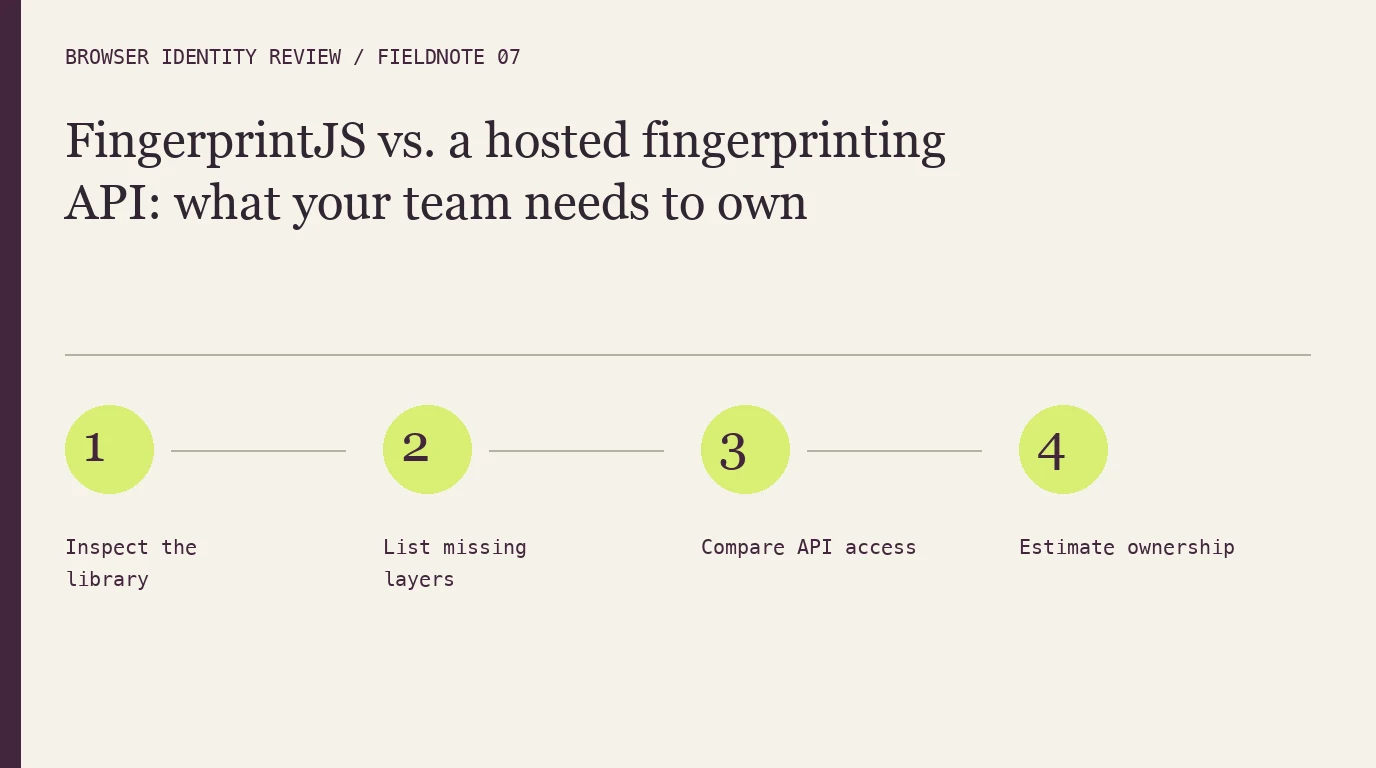
- 1Inspect the library
- 2List missing layers
- 3Compare API access
- 4Estimate ownership
List the work behind the identifier
| Responsibility | Client-only library | Hosted identification service |
|---|---|---|
| Collection code | Inspect and operate the selected version | Integrate the supported client collector |
| Matching across changes | Design and maintain the required behavior | Evaluate the service’s documented matching |
| Integrity and replay handling | Build the trusted application boundary | Verify the provider’s server/result contract |
| Risk enrichment | Add the required evidence sources | Confirm the included signal entitlements |
| Maintenance and operations | Own updates, monitoring and support | Review product coverage, support and terms |
Self-hosting can be a good engineering choice when those responsibilities fit the project. It becomes expensive when the team assumes the local library already solves every production identity problem.
Evaluate open source as a real option
Use the maintainer demo to inspect the local result, then test permitted repeated visits and distinct browsers. Record component changes, collection failures and the work needed to associate a result with an account event.
ThumbmarkJS offers another library-to-hosted path. Its hosted Visitor ID and server components differ from the open-source result. Review the exact option being purchased rather than applying a limitation of the local library to every product under the same brand.
Compare access with equivalent units
ShieldLabs provides 5,000 free identifications and a 99 US dollars/month plan for 25,000 identifications. Fingerprint Pro Plus starts at 99 US dollars/month for 20,000 API calls. Thumbmark Pro lists 15 euros/month for 15,000 API calls, excluding VAT.
Those plans do not establish equivalent features or a universal price ranking. Include the number of protected actions, entitled signals, retention, integration work and review needs. An open-source library has no hosted subscription but still consumes engineering and operating time.
Ask what happens after recognition
A returned identifier might feed personalization, repeat-visit analytics, account-linking or a fraud decision. Each use needs a different amount of context and a different recovery path. ShieldLabs includes account-risk context; a local library needs that layer to be supplied separately where the application requires it.
Use the integration checklist and false-merge evaluation before choosing. A short proof of collection can reveal implementation details, while a longitudinal cohort is needed to evaluate recognition through ordinary changes.
FAQ
Is FingerprintJS the same as Fingerprint’s commercial API?
No. The open-source library and hosted identification product have different architectures and capabilities. Compare the specific product and version.
Is self-hosting automatically cheaper?
It avoids the hosted subscription for the library. Matching, integrity, maintenance, monitoring and support still need to be costed.
Can I replace a local hash with any hosted visitor ID without changing the application?
Do not assume that. Check identifier meaning, event association, result verification and error handling before migrating.
Sources
Checked October 22, 2026: FingerprintJS, Fingerprint pricing, ShieldLabs pricing, Thumbmark pricing. See all alternatives.
Continue reading
- What is a browser fingerprint? From browser observations to a returning visitor
- Browser fingerprinting techniques: compare rendering, environment and network evidence
- Audio fingerprinting in browsers: what the signal can and cannot tell you
Compare all ten tools or read the complete deployment guide.